Numerical investigations
Experiments with Schemes for Exponential Decay
Hans Petter Langtangen
Simula Research Laboratory
University of Oslo
August 20, 2012
Summary. This report investigates the accuracy of three
finite difference schemes for the ordinary differential equation
u'=-au with the aid of numerical experiments. Numerical
artifacts are in particular demonstrated.
Mathematical problem
We address the initial-value problem u'(t)=-au(t),
for t in (0,T], and with initial condition u(0)=I.
Here, I, a, and T are prescribed parameters,
and u(t) is the unknown function to be estimated.
This mathematical model is relevant for physical
phenomena featuring exponential decay in time.
Numerical solution method
We use a mesh in time with equally spaced points.
The theta-rule is used to discretize the differential
equation. This scheme corresponds to
- The Forward Euler scheme when theta=0
- The Backward Euler scheme when theta=1
- The Crank-Nicolson scheme when theta=1/2
Implementation
The numerical method is implemented in a Python function:
def theta_rule(I, a, T, dt, theta):
    """Solve u'=-a*u, u(0)=I, for t in (0,T] with steps of dt."""
    N = int(round(T/float(dt)))  # no of intervals
    u = zeros(N+1)
    t = linspace(0, T, N+1)

    u[0] = I
    for n in range(0, N):
        u[n+1] = (1 - (1-theta)*a*dt)/(1 + theta*dt*a)*u[n]
    return u, t
Numerical experiments
We define a set of numerical experiments where I, a, and
T are fixed, while the time step and theta are varied.
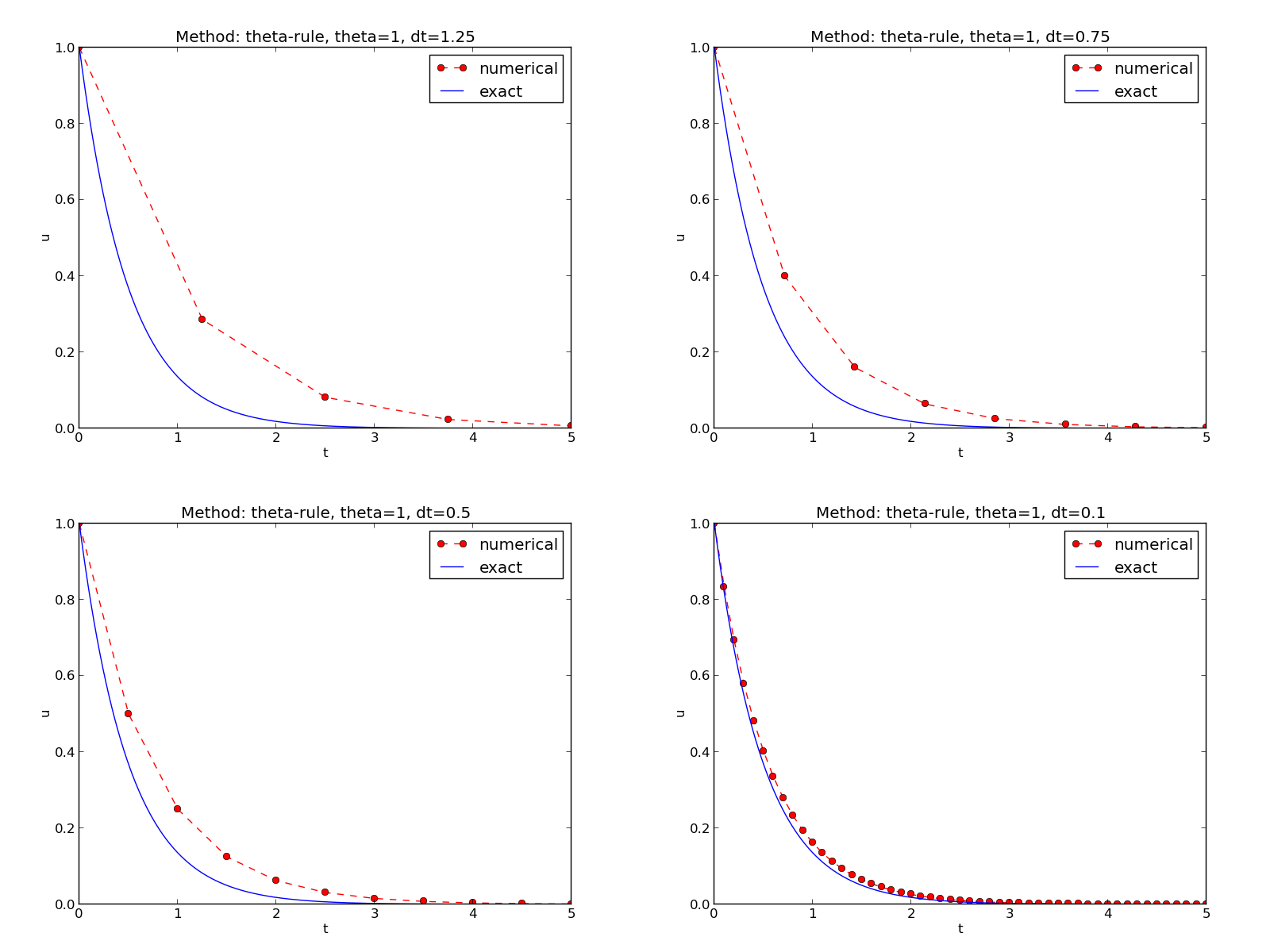
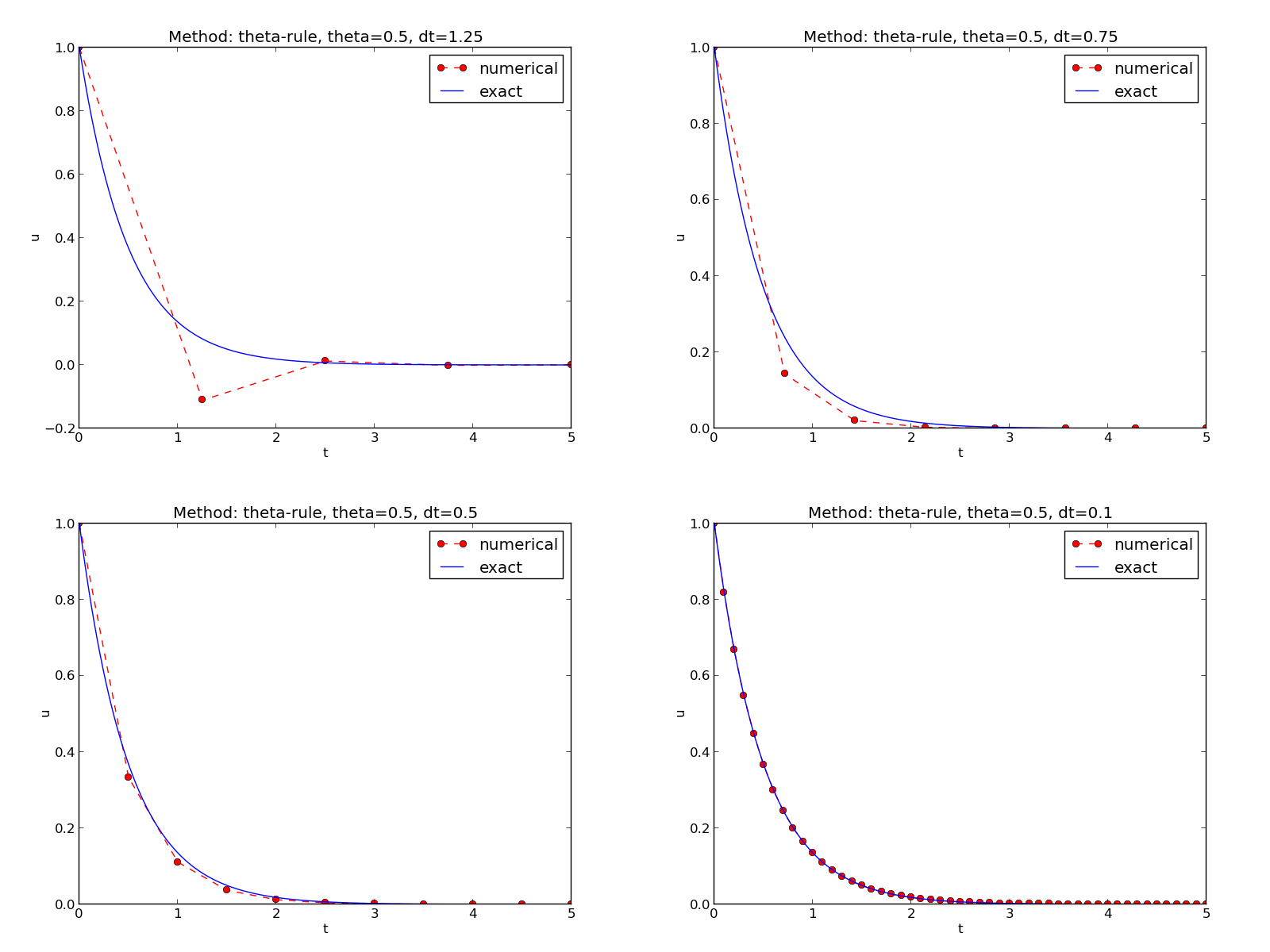
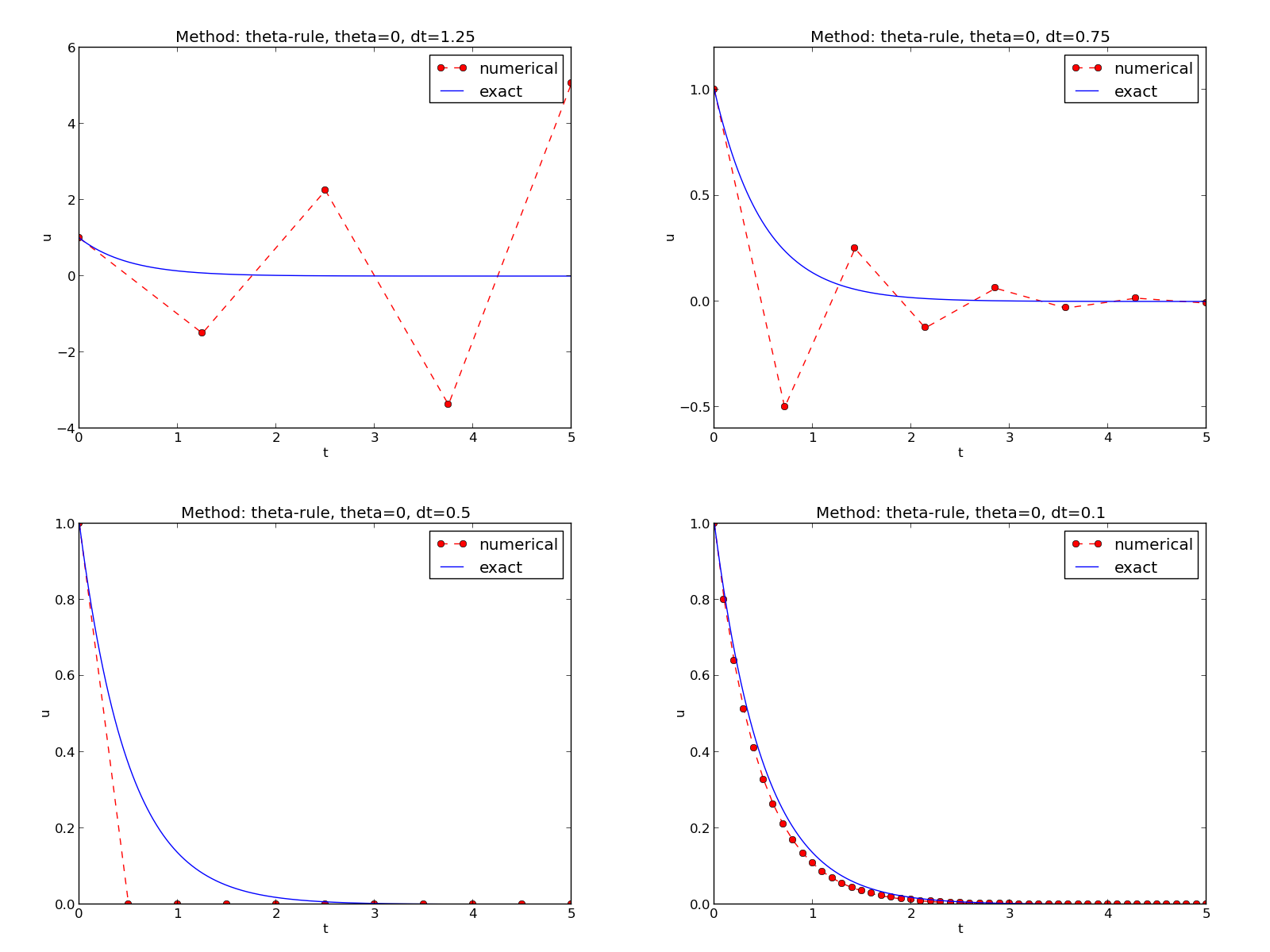
In particular, I=1, a=2, dt=1.25, 0.75, 0.5, 0.1.
The Backward Euler method
The Crank-Nicolson method
The Forward Euler method
Error versus time discretization
How E varies with the time step, for the three discretization
methods, is shown below.